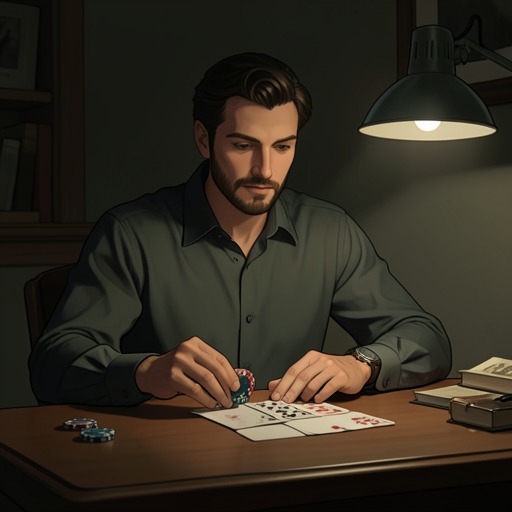
Marco's gambling compulsiveness
The HummingbirdMarco’s gambling compulsiveness is a persistent threat that shapes his relationship with money and risk. After a high-stakes poker duel with Dami Tamburini leaves Marco with an enormous win, he recognizes the game not as a source of security but as a danger he has carried throughout his life; surrendering the winnings becomes part of the insight that redirects him toward caring for Miraijin.
A Long-Carried Threat
Marco describes gambling as a youthful foolishness he never outgrew. He says it had continued to threaten him throughout his life, a danger he had carried without fully understanding. The game therefore represents more than a single episode of excess: it is a recurring vulnerability whose hold becomes visible only when he confronts what winning has actually cost him.
The Poker Duel
In a Texas poker game, Marco and Dami Tamburini end up playing against each other. Dami begins losing, then keeps replaying in an attempt to recover his losses; the contest becomes personal, a reckoning between the two men. Marco later says that in roughly fifteen minutes he won an extraordinary amount. The reversal is stark: Dami is ruined, while Marco’s victory carries its own danger in the form of money and a game he has struggled to leave behind.
Recognition and Reversal
Marco does not keep the photographs his mother left behind: he had disposed of them under the pretext that someone else would value them more, and resolves to retrieve them. He calls their recovery his true win. He insists that he has no need of the money, has always enjoyed working, and has never wanted to live by winnings. In his account, the money is a damnation, not a prize.
The game’s threat becomes legible to Marco that night. He says that he saw the game, and things as they are, clearly; having needed to tell someone, he chose to confide in Dr. Carradori. His decision to give up the great winnings after the duel is later presented as a turning point: an act that helps him understand why he has endured the losses and upheavals of his life. The narrative connects this recognition to his commitment to raise Miraijin, but does not reduce the gambling compulsion itself to a resolved or permanently cured condition.